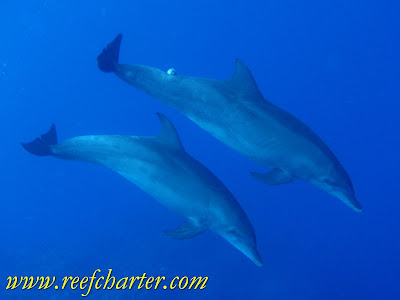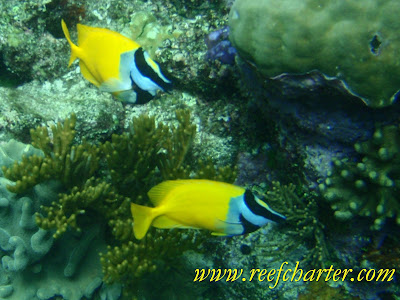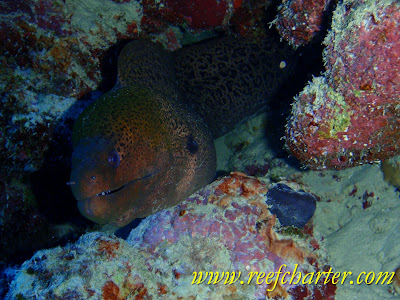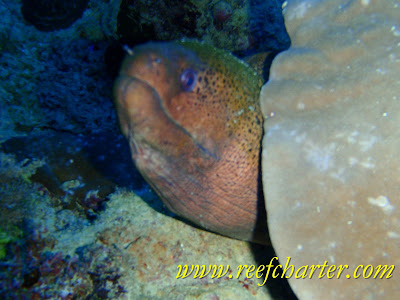
The Outer Great Barrier Reef - Cairns, Australia. The Reef is Yours!
Wally Says - Now is the time to have some fun and experience one of the most unique Natural Wonders of the World: The Great Barrier Reef - Join the Fun - Book Now!
Qantas is taking advantage of some of the incentives offered by the government and again offering some cheap flights to Cairns and the Great Barrier Reef. Here are some samples of the deals on offer. So come on down and say G’day as well as get to see the Great Barrier Reef and world class tropical rainforests for some memories you’ll never forget. For this great offer, start your travel between 1 May and 8 June 2010 or between 24 July and 21 September 2010.
Hurry, this sale expires Tuesday, 23 February 2010.
Los Angeles to Cairns round trip from* $ 898
San Francisco to Cairns round trip from* $ 898
New York to Cairns round trip from* $1098
* Taxes, fees and restrictions apply
More details are available on the Qantas website. Make sure when you come to see the iconic Great Barrier Reef you see it in the possible way, so don’t forget to book your snorkel or dive trip here.
Quick and Fast Facts
• The Great Barrier Reef is the largest structure built by living organisms on the Earth today.
• The Great Barrier Reef region is the world’s largest group of coral reefs.
• There are three main types of reefs found on the Great Barrier Reef: Ribbon, Platform, and Fringing reefs.
• Tiny masses of coral polyps are responsible for building coral reefs.
• Coral Reefs make up 6% of the entire Great Barrier Reef Marine Park by Area.
• Reefs are masses of limestone made from skeletons of millions upon millions of tiny marine animals and plants.
• Main threats to coral reefs include human activities, coral bleaching and crown-of-thorn starfish outbreaks.
The Continental Shelf provides the platform from which the reefs of the Great Barrier Reef develop. In the north, the continental shelf lies close to the coast and gradually widens as it extends south.
How Reefs Protect Themselves
Most reefs have a side protected from the prevailing wind and swell. The exposed face of a reef endures the constant battering of powerful waves generated by high winds. Here, corals and coralline algae grow and bind together to form the limestone breakwater of the reef behind which everything else is sheltered. In these sheltered areas, hard corals, soft corals, algae and sponges inter grow to form gardens that are home to thousands of species.
How Coral Reefs Form
Reefs are masses of limestone made from skeletons of millions upon millions of tiny marine animals and plants. Coral polyps, the main reef builders, grow in colonies on a reef’s surface. They extract dissolved limestone from the water and, with the help of single-celled plants (called zooxanthellae) living inside them, they lay it down as hard limestone around the lower half of their bodies. Over time, polyps slowly multiply to create a coral formation, which varies in size and shape depending on where it lives. People refer to these coral formations by their shape or appearance, for example, staghorn, boulder, vase and plate coral. As a coral grows, new polyps replace old polyps. When coral polyps die, their limestone skeletons and the remains of other animals and plants are added to the framework of the Reef.
Threats to Coral Reefs
Coral reefs in the Great Barrier Reef are under pressure due to a number of threats, from both human and natural impacts. Activities such as diving, boating, anchoring and fishing can affect reefs by damaging corals and impacting on other animals and plants.
Coral bleaching is a natural threat to coral reefs. It occurs when corals are over-stressed and can be caused by extreme sea temperatures, high levels of sunlight, low salinity, diseases, pollutants and exposure to air and rain at low tides.
Crown-of-thorns starfish can destroy entire reefs by feeding on coral polyps. Outbreaks occur and reefs are destroyed when the number of crown-of-thorns starfish on a particular reef is high enough that they are able to consume coral polyps faster than corals can grow.
Types Of Reefs
• Fringing reefs are coral structures that are attached to the mainland or to continental islands. In the Great Barrier Reef most fringing reefs are found around islands. Fringing reefs are probably the reef type most commonly seen by visitors.
• Platform reefs are also known as patch reefs and are scattered in the calm, shallow waters between the mainland and edge of the continental shelf. They are usually round or oval patches and often tend to be broken up.
• Ribbon reefs only occur in the northern part of the Great Barrier Reef. They form along the edge of the continental shelf and can grow so high they form narrow walls.
The last survey results for December 09 have come in and again our crew have done an great job resturning some impressive numbers. Thanks to all the guests who came out with us in the month of December for your valued feedback and hope to see you again.
Market Characteristics:
Guests Home Country: 35% from the UK,
25% 20-29 year olds, 20% 30-39 year olds.
30% Professionals, 45% Travelling with their Partner,
95% First Time Visitors to TNQ, 90% First Time Reef Visitors.
Satisfaction:
Reef Met Expectations: 80% very much / 20% Yes
Trip Met Expectations: 90% very much / 10 % Yes
Received Value for Money: 100%
Would recommend the trip: 100%
Average Score: 9.4 /10
“You Taking a Photo of Me?”
At a request from Rob here is an article on how to take some great photos in the water. Thanks for the suggestion Rob and hope to see you back in Australia shortly. If you have a request for an article on one of our specialties please ping us on Twitter.
1 . As with anything in the water it is best to best to be calm and relaxed and move slowly. Taking photos while in the water either diving or snorkeling takes a little practice and is better if you work with the elements rather then against them.
2. Try to time the taking of the photos with the movement of the water, wind and other environmental variables. Again do not fight them but relax move in harmony with the elements.
3.Whether snorkeling or diving work on your stability in the water that means your buoyancy and how you are able to balance and relax in the water. It will take some practice to be able to become stationary, but well worth the effort.
4. Start taking pictures of fixed objects first such as reefs, underwater structures, corals, etc first. This will help your stability above and give you confidence to be able to frame your picture later. Keep your distance steady, slowly adjust the camera. Making adjustments quickly and constantly will make for erractive and out of focus pictures.
5. Hire a digital camera, this way you can take as many pictures as you want without running out of film. It is best to hire a small compact digital camera without strobes until you get your buoyancy correct. Heavier cameras make it difficult to hold a steady shot for the beginner.
6. Let your dive instructor or guide know that you want to practice taking photos; this will allow them to pick something that will photograph well and also plan the dive appropriately so you have all the time you need to get confident.
7. Ask questions of your tour staff, they will be more then happy to show pointers and evaluate how to improve your photos if you ask.
8. Avoid crowds, dodging other divers and snorkelers will frustrate you as well as take away your focus from your job at hand. Stay with a friend and pay attention to each other to make sure you are in contact, it is very easy to get separated while taking photos.
9. Have fun and try to photograph subject matter you are interested in, this will make the process a lot more enjoyable and you’ll be surprised how quickly you improve if there is a little passion behind your photos.
10. Once you are confident and taking some good photos of corals have a go at the fish or turtles. If the fish or moving animals move away from you do not chase them. No matter how good a swimmer you think you are they are better. Relax and move on to the next object, if you are calm and relaxed they may even circle back giving you another opportunity for that perfect photo.
As you can see to start taking good photos you have to be relaxed and most of all enjoy the experience. After a short time you’ll be taking some great photos that you’ll be proud to show your friends, colleagues and relatives for years to come. Here are some of the photos that our previous guests have taken. You too can be taking some great photos on the reef in a short time also. So if you are heading to Cairns or the Great Barrier Reef we’d love to show you some of the tricks of the trade.
The Diving Industry regulator for Queensland has produced a great poster outlining the responsibilities you have as a scuba diver. The workplace safety organization in Queensland, Australia engages with industry on a regular and consultative basis to ensure we remain the safest place to dive in the world.
The poster is also a reminder for some of the pre-check procedures we as divers sometimes take for granted. If you want a copy of the poster for your dive shop please contact Workplace Safety on 1800 088 200 or via their website
Thanks again to everyone for their support throughout the last year, most of all to our guests and crew and to all our agents and friends. 2009 was one our best years to date with more passengers enjoying the smaller group experience on our yachts then any year before. We saw many great things this year and had some great weather to back it up. The whales are increasing in numbers every year and we have seen larger schools of dugongs again. Manta Rays, Reef Sharks, Turtles, Clownfish and of course the charismatic Maori Wrasse are also amongst the favourites of our guests.
Thanks to all the guests who have recommended our reef trips to their friends, colleagues and family, we hope we have shown them as great a time as you had.
Continued active involvement in the Eye on the Reef program, and Reefcheck Research Programs have kept us all busy with what has been a great year for environmental awareness globally. We hope that 2010 continues to build upon all the work that has been done in the previous twelve months for a better world that will be enjoyed for generations to come.
Once again thanks to everyone and we hope that you have a happy and prosperous 2010!
Tony, Dara and all the New Horizon Team
In keeping with the season another part of the ecosystem of the Great Barrier Reef and one of my favourites is the Christmas Tree Worm. So name because of the shape of the extruding part of the worm. The trees are the mouths of the worm. Christmas tree worms feed primarily by filtering the food from the water around it. Each spiral is actually composed of feather-like tentacles which allows any prey that are trapped in them to be transported straight towards the worm’s mouth. they also use the trees as gills. Any sudden movement or sounds near the worm and it retracts immediately into it’s tube.